
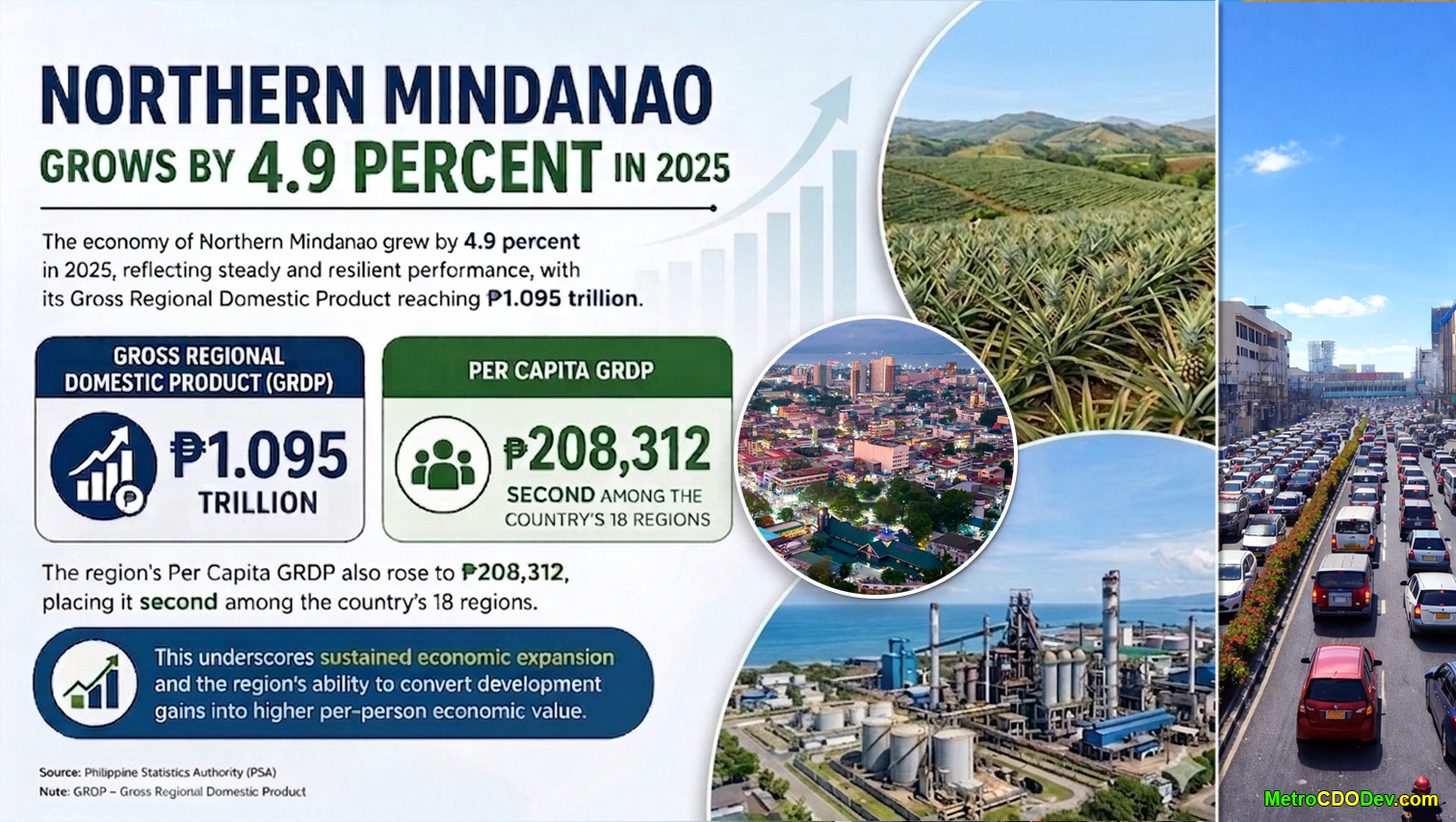
The economy of Northern Mindanao grew by 4.9 percent in 2025, reflecting steady and resilient performance, with its Gross Regional Domestic Product (GRDP) reaching ₱1.095 trillion. The region’s Per Capita GRDP also rose to ₱208,312, ranking second among the country’s 18 regions. This underscores sustained economic expansion and the region’s ability to convert development gains into higher per-person economic value.


Northern Mindanao’s 2025 economic structure highlights the strong performance of Agriculture, Forestry, and Fishing, which ranked as the second largest contributor to the national economy with a 10.3 percent share. The Industry and Services sectors followed, placing sixth with contributions of 4.1 percent and 4.3 percent, respectively. These figures underscore the region’s robust agricultural base, complemented by the steady role of its industrial and services sectors in supporting national economic growth.

Meanwhile, the region’s 2025 Gross Regional Domestic Expenditure reflects a consumption-led economy, with Household Final Consumption Expenditure contributing the largest share at 55.6 percent. Gross Capital Formation accounted for 18.0 percent, while Net Exports to the Rest of the Philippines registered 14.7 percent. Government Final Consumption Expenditure made up 12.9 percent, and Net Exports to the Rest of the World posted a contraction of -1.1 percent. Measured at constant 2018 prices, these figures illustrate the region’s expenditure structure and underlying demand dynamics.

In 2025, Northern Mindanao accounted for 4.7 percent of the Philippine Gross Domestic Product, ranking as the sixth largest regional economy among the 18 regions. This highlights the region’s important contribution to the country’s overall economic performance.

The region’s 2025 Gross Regional Domestic Product shows strong performance across key sectors. Wholesale and Retail Trade; Repair of Motor Vehicles and Motorcycles led the industries, followed by Financial and Insurance Activities. Other major contributors include Electricity, Steam, Water and Waste Management, Manufacturing, Education, Professional and Business Services, and Human Health and Social Work Activities. Overall, the data reflects steady and balanced economic growth in the region.

Northern Mindanao’s economy showed strong growth in 2025, led by Wholesale and Retail Trade; Repair of Motor Vehicles and Motorcycles with a 2.6 percentage point contribution. It was followed by Manufacturing, Financial and Insurance Activities, Education, and Public Administration and Defense; Compulsory Social Security. Together, these sectors supported the region’s overall growth.

Per Capita Household Final Consumption Expenditure in Northern Mindanao continued to rise, from ₱107,815 in 2023 to ₱111,694 in 2024, and further to ₱115,795 in 2025. This corresponds to growth rates of 3.6 percent in 2024 and 3.7 percent in 2025, at constant 2018 prices. The upward trend reflects stronger household spending capacity and sustained consumer demand in the region.

Government Final Consumption Expenditure grew the fastest at 8.5 percent, followed by Exports of Goods and Services to the Rest of the World at 7.0 percent and Household Final Consumption Expenditure at 4.6 percent. Gross Capital Formation posted slight growth of 0.2 percent, while Imports of Goods and Services from the Rest of the World fell by 6.2 percent.

Northern Mindanao’s 4.9 percent growth in Gross Regional Domestic Expenditure in 2025 was mainly driven by Household Final Consumption Expenditure, contributing 2.6 percentage points. This was followed by Government Final Consumption Expenditure at 1.1 percentage points and Net Exports to the Rest of the Philippines at 0.7 percentage point. Net Exports to the Rest of the World added 0.5 percentage point, while Gross Capital Formation contributed 0.04 percentage point. Measured at constant 2018 prices, these figures show the main sources of the region’s expenditure growth.


with images by PSA-X
